Oct 30, 2012

A Chronicle of Limits, Part 6


The following is Part 6 in a series of posts concerning my experience with the Pacific Crest Trail. The previous six parts can be found via the “Blog Archive” down amidst the right-hand column (See October 2012).

Chapter 3:
FRAILTY, THY NAME IS MAN

28 April: Saturday
17:30
Thursday morning, April 26, I awoke to scattered rainfall. Fortunately, it cleared enough for me to pack away a relatively dry tent. Yet again, aside from those not going far, I was one of the last to depart Scissors Crossing. The rain came and went, as did the sun; and the wind was tireless as I climbed the limbo of in and out, up and down, that marked the San Felipe Hills. Looking west across the valley at the mightier Pacific Crest (Volcan Mountain), I cursed the private landowners who forced the PCT to make such a long easterly detour. I cursed a lot that day, some out loud. That was the low state that I was in.
 
I was still very tired. I wondered how my friends were doing. I saw no one on that long 24-mile stretch until reaching my goal, Barrel Springs, at 19:30. The questions—the doubts—plagued me to the fullest. Why was I doing this? Did I really want to hike 2700 miles (my estimated amount including detours and alternate routes) in four months? Could I even hike that far in that amount of time? Some of my responses that day were that I am not built for this: I am a runner; I am an artist: I cannot abandon half of myself for a third of a year; I need to be with people; I need to rest. Yet I do love being on the trail. It is beautiful. I love the sense of ever moving forward: that one does not have to return by the way that he has come—like most of the outdoor courses that I have tread. I love witnessing the change of environment, of geology. It is educational. It is stunning, a testament to life’s diversity and complexity—its variables. Most of all, though, I think that I love the community: the sense of belonging. That is the hardest aspect to leave. If demoted to a section hiker, will I still belong? I will miss being part of that long journey together with people from all places and walks of life—like a church. And yet, would I have mourned equally or greater at the end had I succeeded in completing the trail? Would we have gone our separate ways once again, keeping in some contact at first, but eventually dissipating our communication? Who can say for sure?

I called Mama around 10 miles into the day. I told her where I was at, literally as well as physically and prospectively. Checking back in over an hour, it was decided that they would drive down on Friday (yesterday) to pick me up at Warner Springs. Their sacrifice, dedication, and encouragement are unparalleled. Again, I do not know where I would be without them. Thank you, Mama and Papa.

It was very difficult, but I made it to Barrel Springs before dark. A few others were there, including Castle. She seemed to be doing much better than I was. A trail angel had left cold drinks and cookies. That kind of trail magic goes such a long way. Never underestimate even the simplest of gifts. It was a calmer night. Probably from holistic weariness, I slept better than ever before so far on the trip.

I left camp shortly after a young couple that I had seen at Penny Pines departed. I may have seen them camping at Desert View Picnic Area as well, but I am not sure. About halfway through my 8.5-mile journey across the lovely rolling fields and cow pastures that fill Warner Springs’ southern border, I met the young woman of the couple coming the opposite direction without her backpack. She had lost her husband, apparently. Later, at the Warner Springs Post Office, over some delicious homemade cookies that they shared with me, she told me that she had accidentally taken the wrong path at San Ysidro Creek. They too were not going back to Lake Morena for the PCT Kick-off. I would have liked to get to know that couple better. As they sat in the back of a local woman’s red pickup truck—the same blessed woman who had given me a lift into town—I could not help but feel regret.

The main highlight of the day was stopping to climb the small hill to see Eagle Rock. Nature has a curious sense of humor. 

As if to give me one last slap in the face, as I lay under a Handicapped Parking Only sign between the post office and a “sold out” gas station, a bird shit on me: three small white bombs, four if the small stray moisture that hit my upper lip counts. There are a few ways of interpreting the gesture.

On the PCT register at the post office, I wrote next to my name: “Defeated by my feet . . . for now.” I had realized that morning—and I certainly realize it now—that my feet were in very poor shape. In an effort to compensate, my legs began to also be at risk of serious injury. I could feel the pain gradually moving from my feet to my ankles, up my shins, and beyond.

My tale is not uncommon. I have joined the rumored 50%. Once again, I realize that I cannot do everything that I set out to do. I am weak. I can easily lose will and strength. Almost like a testament to that, a chunk of my yellow LiveStrong bracelet has broken off. I am no hero. I am just like many others.

Only, I try to live in courage, to take serious risks. I try to get back up when I fall. I like to think that I do not give up easily, that I endure. Not everything, but as much as I can. On that road ascending through the San Felipe Hills, I thought of Jesus carrying the cross up Golgotha. Who am I to complain? I was not being mocked, beaten, and scourged. I was not separating myself from God for a time by choosing to receive justice for humanity's frailty. I am not worthy. Praise God for grace and for redemption.

So what do I do now? There are many pages to fill—that need to be filled. First, I heal. And while I heal, I gather what I have learned and consider my options. I am not done with the PCT. That is sure. Though I have been defeated after only 110 miles in six days, There is more will in me. It needs refreshment. It needs a new strategy. It needs redemption. I already have the latter. I only need to let the One who has an unfailing will, work my circumstances to His Kingdom’s glory. I am willing. Come, Lord Jesus, come. “Where you lead us, we will follow . . .” (Jars of Clay/Gungor). Amen.

“. . . and if you don’t keep your feet, there is no knowing where you might be swept off to” (J.R.R. Tolkien).

Oct 29, 2012

A Chronicle of Limits: Part 5

The following is Part 5 in a series of posts concerning my experience with the Pacific Crest Trail. Part 1, Part 2, Part 3, and Part 4 can be found via the associated links.

Chapter 2:
TRAILAHOLISM

28 April: Saturday
12:54
Failure. After only 110 miles, only one completed PCT section (A), I am defeated. How? Why? To what end? These are questions that I must ponder. But I do not think that there are any immediate or clear answers. In some ways I am very disheartened by all this. Yet in part, I consol myself by recognizing that most of the choice—at least the one made in hope of wisdom—was not really mine. In other ways, I welcome the oblivion of uncertainty: the disruption of the unknown. Faith. I find great power in redemption, in how it manifests itself regardless of our human boundaries. But there is still grief. There was so much anticipation, so much preparation—so many imagined memories. As often is the case in my life, I got ahead of reality—or at least tried to. Perhaps that is what defeated me. Can hope be an enemy when it is courted by pride?

To begin to answer the questions, I will first outline my final three days on the trail. In these circumstances there may be some clues.

As usual, I was the last to break camp (Wednesday morning). There is too much that I like to do to prepare for and close a day. I was never even able to do it all. A significant realization that I later had is that my mileage approach to the PCT led to a sort of workaholism—let us call it “trailaholism”: when each day is driven by getting from A to B with little or no true rest, when all that is done is to keep the body progressing. Progress. . . . I hoped to escape it for a time. Yet it dwells within me. How dare I bring it into the wild? No wonder Nature resisted. I forgot why I loved being in nature. I forgot my greatest memories. They are nearly all in stillness: atop a mountain or hill, in a whispering valley—anywhere that I can stop and just listen and receive quiet’s blessings. Naturally, to reach those places takes work, but I let the work define my journey from the start. Timelines. I need to recreate my approach to the PCT. There needs to be lower daily mileage. There needs to be a greater emphasis on people. There needs to be more peace. A new aspect of peace has made itself known: embracing slowness. It is not a profound or new truth. I just understand it better now.

Anyway, I felt tired and footsore as I left Pioneer Mail Trailhead Picnic Area. I hoped to catch up with Ryno and Matt that had left about two hours and an hour before. The day was cooler with scattered clouds and the promise of evening rain. The views were lovely and lonely. My foot pain was my main companion, stealing my attention, my will, and my joy. Yet I pressed ahead steadily.

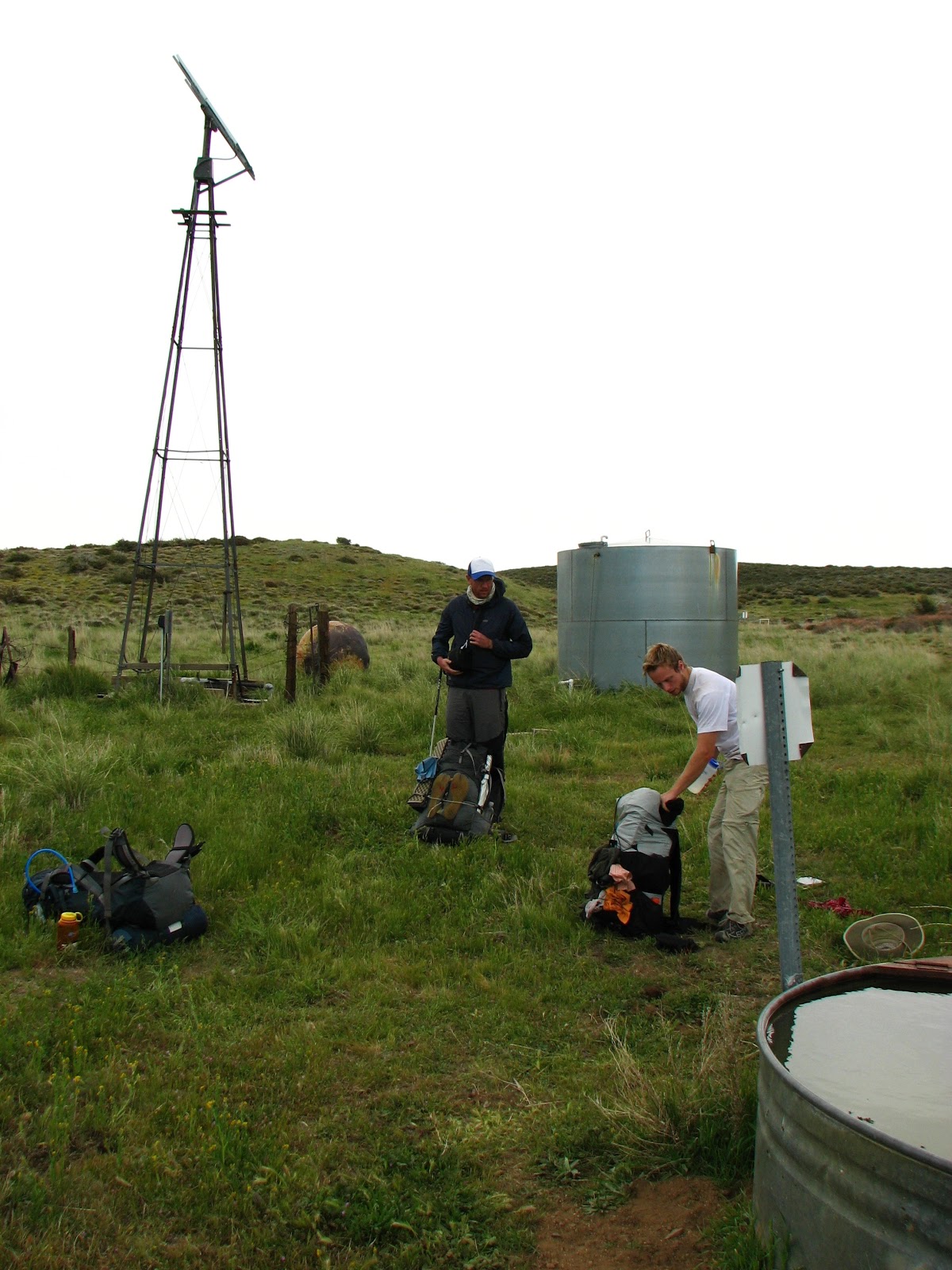
Not long after passing a “SoBo” (South Bound; I am a “No Bo” apparently) group thoroughly enjoying themselves—where was that celebration in me?—I caught up with Ryno and Matt. Their feet were also causing some grief. Yet I wonder how it compared with mine. A highlight of the day was, after passing Monkey and her mother, when we crossed west over Sunrise Highway (S1) toward Cuyamaca Reservoir to rest at a horse trough in a small field of grass buzzing with unobtrusive insects. We restocked our water supplies with our personal filtration systems, took our shoes and socks off, washed our feet, and then let them dry as we propped them on our packs and laid back to nibble and review maps or guidebooks. This is what the PCT is about.

Eventually, we packed everything up and walked the half mile east back to the PCT. At the junction, a young veteran SoBo couple was picnicking. I first heard the NoBo-SoBo terminology from them. Ryno had heard the term “NoBo.” I replied, “like hobos . . . or nobodies . . .” with a smile. The couple was going to the official PCT Kick-off at Lake Morena during the upcoming weekend (i.e. presently). We were thoroughly encouraged to attend. Probably nine out of ten people we meet encourage us to do so. Many people hike the first section (A: Mexican Border to Warner Springs) before attending the kick-off. They are then afforded a few days to rest and heal. That seems smart. As lively as it sounds, I was not sure that I had been convinced to attend. A lot of drinking is apparently involved.  Many people get their trail names during that weekend. For example, one seemingly unfortunate lad lost a drinking contest to a woman. She, as a reward, named him “Mangina.” Apparently, he is proud of the name and was only too ready to tell others about it. Regardless, I mostly justified my reason not to attend by the fact that I did not have the extra supplies or transportation coordinated to backtrack and forth those few more days.

After our conversation, Ryno, Matt, and I left the couple, and I felt a wave of focus and strength—and relative painlessness—rise within me. I pushed ahead with an ambitious sense of getting back on schedule by reaching Scissors Crossing that evening, which would result in a 26-mile day. I sort of regret this decision. I loved being with Ryno and Matt. I just got distracted by the “necessity” to reach Warner Springs before Saturday (today) in order to guarantee picking up my first re-supply box without delay (the Post Office is closed Sundays). Yet I feel like I abandoned them in my brief period of strength. Do I often distance myself from people with my sense of resolve or discipline or call it what you want? I usually fear being abandoned by others. It has seemed to happen a few times. Though those people may have had different reasons than me, perhaps I would be a hypocrite not to recognize the same essence within me: abandonment justified by some personal conviction. Have I really ever sacrificed, purely without selfish motivation? As I recover and reorganize, assuming Ryno and Matt are still on the trail, I hope to get in touch with them to reconnect somewhere further along, such as in Yosemite National Park.

Meanwhile, I felt invigorated. I felt my old strength. I passed Heather and Monkey. I passed SoBo hiker “Don’t Panic” as I made the steep descent to Chariot Canyon. I climbed up to the ridge between it and Rodriguez Canyon, hollering back to Ryno and Matt a few times as I noted their slower progress below. I reached Rodriguez Spur Truck Trail just before dusk. Paul was there, setting up camp along with another couple. I cannot remember his name, but the husband and I spoke some German together. He had studied near Hannover for six months.

I knew that Ryno and Matt would probably camp at Rodriguez Spur Truck Trail for the night. It was a lovely spot. The San Felipe Valley stretched out below. I probably should have stayed. Yet my timeline lingered—persisted even—in my thoughts. I was tired. But I was determined.

The next 9.2 miles were lovely, especially with the sunset over the San Felipe Valley. That glorious view was God speaking to me about redemption. A few F-16 Fighter Jets even flew south over the valley toward the training zones east of the Laguna Mountains. I passed one other SoBo hiker along the way. I quickly began to tire. Seeing a house nearby at one point, I imagined a trail angel family welcoming me into their home where other hikers were staying for food, fellowship, and civilized comforts. Alas, it was to be a lonely night. I became fatigued. Once I reached what Don’t Panic had called “No Man’s Land”—Earthquake Valley between Granite Mountain and Grapevine Mountain—I was struggling to walk steadily. A few miles away from Scissors Crossing, I found shelter from increasingly harsh winds behind a large bush to cook what I intended to be my first dinner course: a freeze-dried meal. It helped. As the sky darkened, others creatures began their own supper routines. A few silhouettes of what were either desert foxes or coyotes ran stealthily across my path. After refilling at a blessed water cache near the S2 (road), I left the trail in hopes of hitchhiking the last 1.2 miles. That was unsuccessful. In a dark loneliness I continued, with a small circle of light from my flashlight to guide me.

At last I reached the bridge that marks Scissors Crossing. A camp consisting of four tents was setup on the sand under the bridge. The men there were friendly. They had selected that spot to avoid the expected 1.5 inches of rain to come that night. They told me of a water cache waiting across the dried creek, at the other end of the bridge. I chose not to camp with the men mostly because it was a bit crowded, but also due to the wind and sand blowing, and only slightly because I was not in the mood to socialize more with what seemed to be four gay men—a few of them started singing together after I left.

A few other camps had been set up a short ways away out in the open. My feet were really killing me. I was tired and grimy, and not in the mood for a stormy evening. I stumbled around awkwardly for a while. The bridge group led me to think that there was a campground nearby. A curt word from one uninterested camper let me know that I could just camp anywhere. I was hoping to find someone familiar, but it was just too dark and late.

I eventually found what seemed to be a suitable spot. Its disadvantage was that it was surrounded on three sides by a briar patch. When this settled into my now half-conscious mind, I was already too progressed with setting up my tent to feel like seeking another spot. My fingers were stabbed by the briars a few painful times as I used my Leatherman saw to remove branches that could potentially snag my gear or myself. This took too long. But I did not want to stumble out of my tent in the rainy night in hopes of relieving my bladder to instead get tangled in the embrace of an angry plant. Now, the advantage of the campsite was that it was protected against the wind, not to mention any intruders. Like lions . . .

By the time everything was set, I was in no mood to cook again, though I was hungry. My weariness took precedent. After going to the east side under the bridge to try to tend to my feet—somewhat in vain—I retreated to my tent, not even bothering to brush my teeth. I was tired and demoralized. My feet were grievous. I felt grimy from blowing sand. I was hungry and lonely. I could barely think to get organized in my tent—a challenge amplified by bad weather and doing so at night—and my clothes smelled rather putrid. Not to mention that I had cursed to myself more than I like. God forgive me. I eventually found some sleep. I was in too poor a mood to want to call Mama & Papa.

This was a low point.